HUMANITY FILES
Marshall Islands Nuclear Testing
Sixty-seven U.S. nuclear tests and the communities that lived with the consequences
Bikini and Enewetak Atolls · 1946–1958
Summary
Between 1946 and 1958, the United States conducted 67 nuclear weapons tests in the Marshall Islands. The program transformed Bikini and Enewetak into proving grounds for increasingly powerful weapons and displaced island communities from ancestral homelands. The most consequential single test was Castle Bravo on 1 March 1954. Its explosive yield greatly exceeded the scale planners had expected. Radioactive fallout spread beyond the exclusion area and exposed people on Rongelap and Utrik, among others. The United States subsequently evacuated affected communities, conducted medical monitoring and created long-term health and environmental programs. The history is not only about radiation dose — it is also about consent, displacement, land, culture and power. The documentary record clearly establishes testing, relocation, fallout exposure and long-term contamination concerns. More difficult questions concern the precise health effects attributable to radiation in small populations, whether relocation decisions can meaningfully be described as consensual under a U.S.-administered strategic trusteeship, and whether later compensation mechanisms adequately addressed the losses.
Estimated Impact
The United States conducted 67 nuclear weapons tests in the Marshall Islands (1946–1958); the Government Accountability Office recorded 167 people relocated from Bikini and 142 from Enewetak to permit testing. Humanity Files does not publish a single aggregate radiation-death total — see 'Radiation and Health' below for why.
Small population sizes, differing individual doses, migration, changing medical conditions over decades, and uncertainty about individual disease causation make a single aggregate "deaths caused by testing" figure methodologically weak; Humanity Files distinguishes documented exposure (strong evidence) from attribution of specific later illness or death to that exposure (not scientifically justified without case-specific evidence).
Before the Tests
After World War II, the United States administered the Marshall Islands as part of the Trust Territory of the Pacific Islands under a United Nations trusteeship arrangement. The territory had strategic importance in the emerging Cold War.
Bikini Atoll was selected for the 1946 Operation Crossroads tests. The people of Bikini were relocated. A U.S. Government Accountability Office report later summarized that 167 people from Bikini and 142 from Enewetak were moved to other locations to facilitate the testing program.[1]
The language surrounding these removals matters. Contemporary accounts sometimes present Bikinian agreement as voluntary participation in a project “for the good of mankind.” Later scholarship and Marshallese testimony emphasize the unequal power relationship involved: an island community under U.S. administration faced a request from the government controlling the territory and the military resources around it.
Humanity Files therefore does not reduce the issue to a binary label of “voluntary” or “forced” without context. It documents the conditions under which the decision occurred.
What Happened
From 1946 to 1958, 67 U.S. nuclear devices were tested in the Marshall Islands.[2] The tests ranged from early atomic weapons to enormously powerful thermonuclear devices.
Bikini and Enewetak
Testing required the removal of residents and transformed parts of the northern Marshall Islands into militarized scientific spaces. Some communities endured repeated relocation as initial resettlement sites proved inadequate for sustainable life.
Castle Bravo
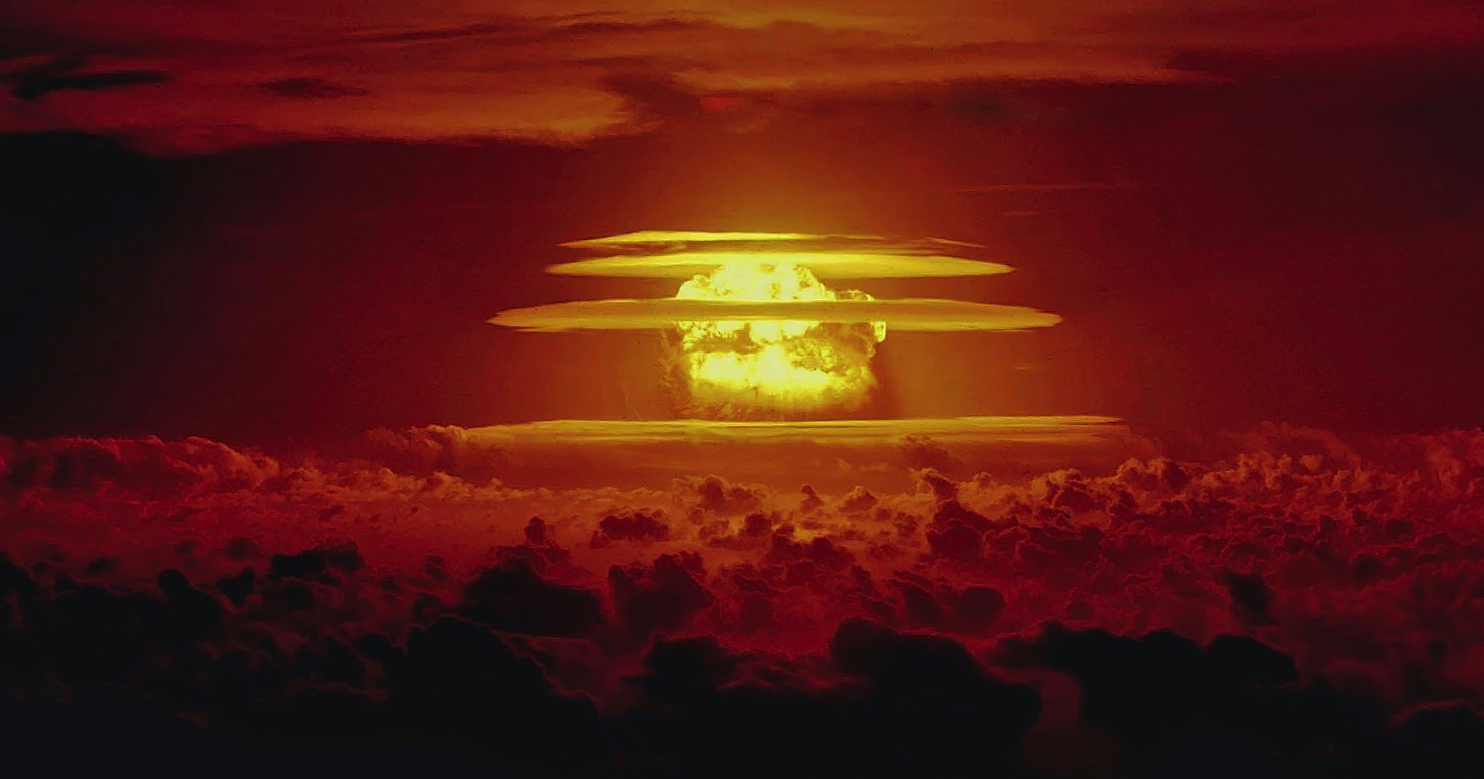
On 1 March 1954, the United States detonated Castle Bravo at Bikini Atoll. Bravo was the first test of a deployable dry-fuel thermonuclear design of its type. Its yield was far greater than planners had expected.
The fallout plume travelled eastward beyond the test area’s exclusion zone. U.S. Department of Energy historical material shows the fallout path crossing inhabited atolls including Rongelap and reaching Utrik; a Japanese fishing vessel, Daigo Fukuryū Maru (Lucky Dragon No. 5), was also exposed.[4]
Residents of Rongelap and Utrik were evacuated after exposure. DOE continues to operate a Special Medical Care Program for specific populations directly exposed to Castle Bravo fallout.[3]
Who Was Affected
The consequences varied by atoll.
Bikini: Residents were relocated to permit testing and later attempts at return proved unsustainable because of radiation concerns. The U.S. Department of the Interior notes that Bikini has remained uninhabited since residents were removed again in 1978 after renewed radiological concerns.[5]
Enewetak: Residents were relocated; a large cleanup program later preceded return. Radioactive debris and contaminated soil were placed in the Cactus Crater and covered by the structure commonly called Runit Dome.[6]
Rongelap and Utrik: Residents were exposed to Castle Bravo fallout and evacuated. Their subsequent medical monitoring became part of the long-term U.S. response.[1][3]
The effects were therefore physical and social: exposure, disrupted subsistence, repeated movement, loss of reliable access to ancestral land and uncertainty about whether food and soil were safe.
Radiation and Health
The strongest causal evidence concerns the populations with documented fallout exposure, especially after Castle Bravo. DOE’s current program explicitly provides cancer screening and treatment to designated exposed populations from Rongelap and Utrik.[3]
However, Humanity Files does not publish a single aggregate number of “deaths caused by nuclear testing” across the Marshall Islands. Small population sizes, differing doses, migration, changing medical conditions and uncertainty about individual disease causation make such a total methodologically weak.
The correct distinction is:
- Documented exposure: strong evidence.
- Elevated risk for particular radiation-related conditions in exposed populations: supported by medical research.
- Attributing every later illness or death in affected communities to testing: not scientifically justified without case-specific evidence.
Project 4.1 and Medical Ethics
After Castle Bravo, U.S. researchers studied exposed Marshallese populations. The program became known in part through Project 4.1, concerning the effects of fallout on human beings.
The ethical issue should be stated carefully. The residents were not deliberately exposed for the purpose of the study; the exposure occurred because of the weapons test and fallout. But the subsequent medical research has been criticized over informed consent, communication, the dual role of doctors and government researchers, and the extent to which affected communities understood the research relationship.
Those questions belong within the later development of modern research ethics, especially where populations harmed by state activity also become subjects of state-sponsored scientific study.
The Official Justification
The U.S. testing program was driven by national security and Cold War weapons development. American officials believed nuclear superiority and thermonuclear capability were essential in competition with the Soviet Union.
The Marshall Islands offered remote test locations under U.S. strategic administration. That strategic logic helps explain why the tests occurred there. It does not answer the separate questions of consent, environmental stewardship or the adequacy of protection for communities living in the region.
What the Evidence Shows
Well Established
- The United States conducted 67 nuclear tests in the Marshall Islands between 1946 and 1958.[1][2]
- Bikini and Enewetak communities were relocated to facilitate testing.[1]
- Castle Bravo produced fallout outside the planned exclusion area.[4]
- Residents of Rongelap and Utrik were exposed and subsequently evacuated.[1][3]
- Long-term U.S. medical and environmental monitoring programs remain in operation.[3]
- Runit Dome contains contaminated material from cleanup activities at Enewetak.[6]
Strongly Supported
- Relocation caused deep social and cultural disruption.
- The relationship between U.S. authorities and island communities was profoundly unequal.
- The Bravo event exposed weaknesses in fallout prediction and protective planning.
Uncertain or Disputed
- The precise amount of later disease attributable to testing across all Marshallese populations.
- Whether the 1946 Bikini relocation can meaningfully be described as free consent.
- The adequacy of compensation and legal settlements.
- The degree to which Project 4.1 met ethical standards that would later become expected in human-subject research.
Compensation and Legal Settlement
The 1986 Compact of Free Association and its Section 177 agreement created a framework intended to settle nuclear-testing claims and fund compensation mechanisms.[7]
The Nuclear Claims Tribunal later made awards connected to personal injury and property losses. Disputes continued over whether the settlement was adequate relative to the scale of damages and whether changed circumstances justified additional U.S. responsibility.
The Department of the Interior notes that U.S. programs continue to address parts of the nuclear legacy even while legal and political disagreements remain.[2]
Human Consequences
For affected Marshallese communities, “damage” cannot be measured only in radiation units. Land in an atoll society is connected to kinship, subsistence, navigation, burial, memory and political identity. Removal can therefore produce a form of loss that money does not straightforwardly repair.
Communities also experienced uncertainty: whether it was safe to return, whether local foods could be eaten, whether children’s illnesses were connected to radiation, and whether official reassurance could be trusted after earlier failures.
What Changed Afterwards
The Marshall Islands became one of the world’s central case studies in fallout, environmental monitoring, nuclear-test compensation and the ethics of conducting high-risk state programs in territories whose inhabitants have limited political power.
Castle Bravo also influenced global public concern over atmospheric testing. Fallout ceased to be a remote technical issue and became an international political problem, contributing to pressure that eventually produced the 1963 Partial Test Ban Treaty.
Questions That Remain
- What constitutes meaningful consent when a strategic administering power asks a small island community to surrender its homeland?
- How should compensation account for cultural and intergenerational loss, not only property value?
- How should epidemiological uncertainty be communicated without minimizing documented exposure?
- What duties persist after a state declares legal claims settled?
- How should climate vulnerability interact with responsibility for contaminated sites such as Runit Island?
Ideas Behind This File
Institutions
Sources & Evidence
Official Records
Foreign Relations: Better Accountability Needed Over U.S. Assistance to Micronesia and the Marshall Islands
Verified 2026-09-20 (GAO/RCED-00-67, p.13): "The Marshall Islands was the site of 67 U.S. nuclear weapons tests in the 1940s and 1950s. In order to conduct these tests, the United States moved 167 people from Bikini Atoll and 142 people from Enewetak Atoll to other locations."
Marshall Islands Program
Government program providing ongoing medical and environmental monitoring.
Atoms for Peace and War, 1953–1961
Includes the Castle Bravo fallout map and test history.
Marshall Islands Compact of Free Association
Legal and compensation framework, including the Section 177 agreement.
Books
Nuclear Playground
Last reviewed: September 20, 2026. Found an error? See our corrections policy.