HUMANITY FILES
Tokyo Firebombing
Operation Meetinghouse and the destruction of an urban population
Tokyo · 9–10 March 1945
Summary
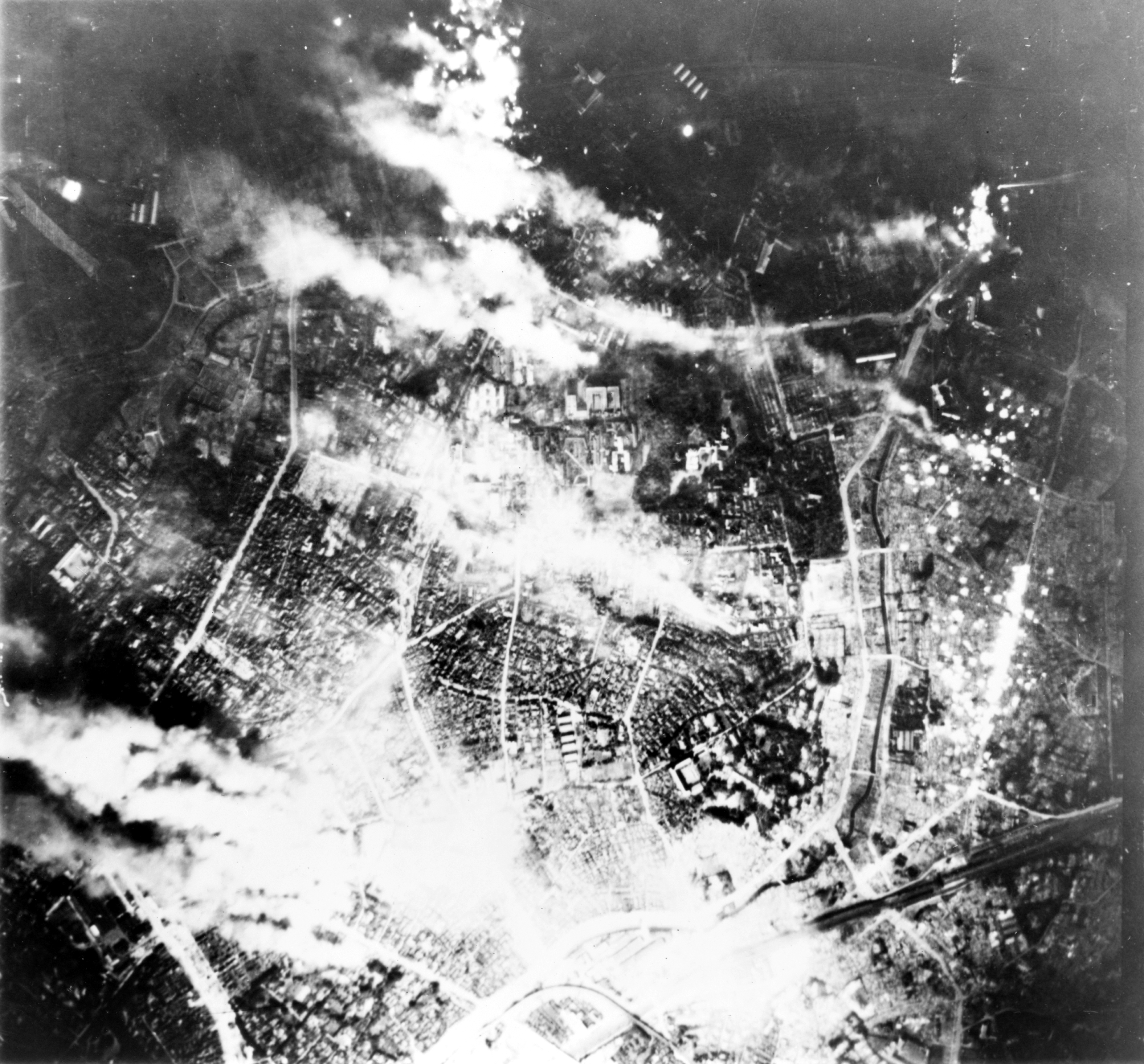
On the night of 9–10 March 1945, U.S. B-29 bombers attacked Tokyo with incendiary weapons in Operation Meetinghouse. The raid marked a major shift in the American strategic bombing campaign against Japan: from high-altitude attacks intended to strike industrial targets toward low-altitude night attacks designed to burn broad urban-industrial districts. Tokyo's war economy was not divided neatly between factories and homes. Small workshops and subcontractors were dispersed through dense residential areas, while much of the city's construction was highly vulnerable to fire. The resulting conflagration devastated large sections of eastern Tokyo. Casualty estimates vary: the U.S. Navy's official historical overview describes the raid as having claimed an estimated 100,000 lives, while other U.S. military histories cite figures around 83,000 or more than 80,000. Tokyo matters to Humanity Files because it demonstrates that mass urban destruction did not begin with nuclear weapons — months before Hiroshima, conventional incendiaries had already shown that modern air power could destroy a city district and kill tens of thousands of people in a single night.
Estimated Impact
U.S. official and military-history sources give different figures for the 9–10 March raid — approximately 100,000 (Naval History and Heritage Command), 83,793 (Air & Space Forces Magazine), and 'more than 80,000' (a separate Air & Space Forces history) — reflecting the limitations of wartime casualty reconstruction after a firestorm, not disagreement that mass death occurred.
Why estimates vary
- U.S. Naval History and Heritage Command: approximately 100,000 deaths — Naval History and Heritage Command, Japan's Surrender and Aftermath
- Air & Space Forces Magazine (I): 83,793 deaths — Air & Space Forces Magazine, The Invasion That Didn't Happen
- Air & Space Forces Magazine (II): more than 80,000 deaths; approximately 1,000,000 homeless — Air & Space Forces Magazine, The Twentieth Against Japan
The differences reflect wartime counting problems, bodies destroyed by fire, population movement and the difficulty of separating immediate from later deaths — not evidence that the event is poorly documented.
Before the Event
The United States began B-29 operations against Japan from the Mariana Islands in late 1944. Early high-altitude precision bombing produced disappointing results because of weather, the jet stream, cloud cover, technical limitations and the dispersed character of Japanese war production.
Major General Curtis LeMay changed tactics. B-29s increasingly attacked at night and at lower altitude, carrying large incendiary loads. The logic was military and industrial: Japanese cities combined major factories with thousands of smaller workshops, transport systems and residential neighbourhoods supporting war production. The moral consequence was that the distinction between the industrial target and the civilian city became increasingly difficult to maintain in practice.
Japan itself had conducted devastating bombing and mass violence in China and elsewhere. That context is essential to understanding the war, but it did not change the physical vulnerability of civilians in Tokyo or transform them into combatants.
What Happened
More than 300 B-29s were dispatched toward Tokyo during the night. U.S. Air Force historical accounts describe the raid as involving roughly 334 aircraft and about 2,000 tons of bombs, overwhelmingly incendiaries.[5]
The target area included densely packed districts of eastern Tokyo. Pathfinder aircraft marked zones, after which streams of bombers released incendiary clusters. Individual bomblets scattered across rooftops and streets, starting thousands of fires.
Weather conditions and urban construction helped those fires merge into a vast conflagration. Strong winds drove flames through neighbourhoods. Escape routes became congested. Canals and rivers that might appear to offer safety could become death traps as heat and smoke overwhelmed people seeking refuge.
The attack burned roughly 15–16 square miles of the city according to U.S. military histories.[1][5] Around one million people were left homeless in commonly cited estimates.[5]
Who Was Affected
The principal victims were urban residents: families, children, elderly people, workers and people already living under the constraints of wartime mobilization.
Tokyo also contained military facilities, industrial plants and a network of small-scale production connected to Japan’s war economy. That mix is central to the historical debate. American planners did not view the area as purely residential. Yet the chosen method — mass incendiary attack on a densely populated urban zone — made large-scale civilian death foreseeable.
Deaths and Casualty Estimates
There is no single universally accepted figure.
U.S. official and military-history sources provide different estimates:
- The Naval History and Heritage Command uses about 100,000 deaths for the first major firebombing raid of 9–10 March.[1]
- An Air & Space Forces historical article cites 83,793 deaths.[4]
- Another Air & Space Forces history describes more than 80,000 deaths and approximately one million homeless.[5]
These differences are not evidence that the event is poorly documented; they reflect the limitations of wartime casualty reconstruction after a firestorm.
Humanity Files therefore uses:
Estimated deaths: roughly 80,000–100,000 in the 9–10 March raid, with some estimates higher.
The Official Justification
The strategic logic was to destroy Japan’s capacity to continue war by attacking industrial production, including dispersed manufacturing embedded in urban neighbourhoods. U.S. planners believed fire was particularly effective against Japanese cities and their built environment.
That rationale reflected the broader doctrine of strategic bombing: war could be shortened by destroying not only armies in the field but also the economic and urban systems sustaining them.
By 1945, this logic had been applied by several belligerents in Europe and Asia. The question is not whether Tokyo contained military-industrial targets — it did — but what limits should apply when the chosen method predictably destroys whole residential districts around those targets.
What the Evidence Shows
Well Established
- The United States carried out a large low-altitude incendiary raid on Tokyo on the night of 9–10 March 1945.
- Hundreds of B-29s participated and large quantities of incendiaries were dropped.[5]
- Large areas of the city burned.
- Tens of thousands of civilians died, with official U.S. historical estimates ranging around 80,000–100,000.[1][4][5]
- Approximately one million people were made homeless in commonly cited military histories.[5]
Strongly Supported
- The shift to incendiary area attack reflected frustration with high-altitude precision bombing and the dispersed nature of Japanese industry.
- Civilian mass casualties were foreseeable given the target area, construction and weapon type.
- Tokyo’s destruction became part of a broader incendiary campaign against Japanese cities before the atomic bombings.
Uncertain or Disputed
- The exact death toll.
- How much the bombing shortened the war.
- Whether the military-industrial value destroyed was proportionate to the civilian harm.
- How to compare the raid morally and strategically with Hiroshima and Nagasaki.
Historical Debate
Supporters of the strategic bombing campaign emphasize Japan’s mobilized war economy, dispersed production, the urgency of ending the war and the difficulty of accurately striking individual targets in 1945.
Critics argue that the method amounted in practice to area bombing of civilian populations, and that the destruction of homes and noncombatants was not an accidental side effect but an inherent feature of the operational plan.
A further debate concerns memory. Hiroshima became the defining global symbol of bombing in Japan because nuclear weapons introduced radiation effects, a new category of weapon and the possibility of civilization-scale destruction. Tokyo, despite a comparable or even greater immediate death toll than either atomic-bombed city in some estimates, occupies less space in global public memory.
That difference does not require a conspiracy explanation. Nuclear weapons transformed international politics, produced a recognizable single-event image and created an enduring nuclear-age narrative. Tokyo belonged to the already familiar category of conventional bombing, even though its human scale was extraordinary.
Human Consequences
The firestorm killed by burning, smoke inhalation, crushing, heat exposure and drowning. Families were separated in darkness and smoke. Large numbers of survivors lost homes, possessions and neighbourhood networks overnight.
The destruction of urban infrastructure created secondary suffering: shortages, displacement, loss of employment and reduced medical capacity. Tokyo was repeatedly bombed after March, so the 9–10 March raid should be understood as the most lethal episode within a wider campaign rather than the city’s only attack.
Accountability and Recognition
No postwar criminal prosecution was brought against the U.S. commanders responsible for the Tokyo firebombing campaign. Strategic bombing by the victorious Allies did not become a subject of prosecution comparable to Axis war crimes tribunals.
The historical issue therefore remains primarily one of ethics, military doctrine, law, commemoration and scholarship.
What Changed Afterwards
Tokyo demonstrated the destructive potential of conventional air power at metropolitan scale. It also foreshadowed a problem that would persist into later wars: when military production, infrastructure and civilians occupy the same urban space, strategic bombing can redefine an entire city as a target system.
The atomic bombings later overshadowed the incendiary campaign, but the Tokyo raid remains essential for understanding the evolution from industrial warfare to nuclear warfare.
Questions That Remain
- When does attacking an industrial network become attacking a population?
- Can an urban area be treated as a military target because production is dispersed through homes and workshops?
- How should proportionality be judged when a method is known to create uncontrollable fire?
- Why do some mass-casualty events become universal symbols while others remain nationally remembered?
- Did strategic bombing shorten the war enough to justify its civilian cost?
Ideas Behind This File
Institutions
Sources & Evidence
Official Records
Japan's Surrender and Aftermath
States the 9–10 March Tokyo raid "claimed an estimated 100,000 lives."
Effects of Air Attack on Urban Complex Tokyo-Kawasaki-Yokohama
Books
Among the Dead Cities: The History and Moral Legacy of the WWII Bombing of Civilians in Germany and Japan
Investigative Reporting
The Invasion That Didn't Happen
Verified 2026-09-20: article states "the bombers destroyed 16 square miles of Tokyo and killed 83,793 Japanese."
The Twentieth Against Japan
Describes 334 B-29s, about 2,000 tons of bombs, more than 80,000 deaths and about one million homeless.
Last reviewed: September 20, 2026. Found an error? See our corrections policy.